
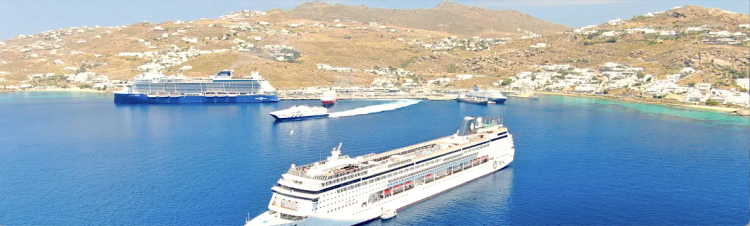

Little Venice – Mykonos Old Town Harbor
Port of Call: Mykonos had been in our dreams as a place we wanted to visit badly. Well really it was one of the reasons we had booked the cruise extension in Barcelona. We know that Mykonos is a destination island for sun vacations, so booking a a shore excursion was out of the question. We were going to stretch our legs and explore the town bi-pedal.
Greece has between 1,200 and 6,000 total islands and islets, depending on the minimum size counted, with the Hellenic Military Geographical Service citing up to 29,372. Of these, only about 166 to 227 are inhabited, scattered across the Aegean and Ionian seas. With a population of a little over 10,000 people and a surface of 33 sq.miles, Mykonos takes place 33 in the line up of Greek Islands. Can’t help but compare Mykonos to our Beaver Island numbers and realize that Mykonos is only 3/5 of Beaver Island which houses about 600 people.
There are many islands surrounding Mykonos, like the famous Santorini, the islands of Andros, Tinos, Milos, Ios, Syros, Paros and Naxos. These islands have daily connections to Mykonos, so if you combine boats you can visit even more islands and add more destinations to your greek island hopping experience. Tinos, which is less developed but larger in size, is immediately located to the north and worth a visit by ferry.



Recent Comments