Port of Call: Pago Pago, American Samoa

Magnificent Ocean Scenes abound

Pago Pago, the capital of American Samoa,  comprises of a string of coastal villages on Tutuila Island. The letter “g” in Samoan sounds like “ng”; thus Pago Pago is pronounced “pahngo pahngo”. It’s a gateway to the National Park of American Samoa, which protects lush rainforest, coral reefs and waters visited by humpback whales.

It was quite a sail from Maui, Hawaii down here. 2,575 nautical miles to be precise, more than 6 days, during which quite a few of the 2,500 passengers got an upper respiratory infection that did not want to go away. Upon arrival there were a couple of ambulances waiting at the bottom. Some passengers were taking off the ship. Of course you want to go on land, although you don’t feel like it. We went to find Vicks Vaporub, but at the end of the day all we found was some kind of local cold remedy that featured the name Vicks but did nowhere near have  its potency. We know, we’re experts on the matter.

J.P. Haydon Museum

Fagatogo village (the capital?!) is home to the Jean P. Haydon Museum, exhibiting local historic artifacts in a former U.S. Navy facility. A trail leads up to Blunts Point Battery, a WWII gun site

After several centuries of colonial back and forth between England, Germany and the USA, Pago Pago finally became a US territory in 1900. The reason for the long fight was actually the natural deep, very protected harbor of Pago Pago and the fact that the island was located smack in the middle of the best whaling grounds in the world. Always keen to discover good deals, the Americans quickly figured out they could catch and process large predatory fish such as tuna and swordfish right off the deep harbor.

During our ship’s arranged tour we learned that Tuna canning is the main economic activity in town. Exports are almost exclusively from tuna canneries such as  Chicken of the Sea and Starkist (Heinz), which are both located in Pago Pago. 14% of the population is employed here and they export close to half a billion US dollars of canned fish and pet food a year.

He just drove while she talked…

Our tour vehicle needs a separate description for readers that are not used to exotic islands and road conditions. We’re talking a 1975 or there about, chassis of a Ford/Chevy or Datsun/Toyota truck, completely rebuild with a passenger wagon, hand-built for some 12 to 16 passengers and decorated by everything that  may make you feel comfortable such as curtains and kitchen items or religious relics of questionable history. The tour was only $25 per person, but on several occasions we thought the truck’s sounds indicated it was done and over with. Probably that is the charm however. The driver and his wife with an unpronounceable mile long name took us around the middle of the island with many little villages up and down the road. What’s interesting is to see that many houses have their own little graveyards, only meant for family. This is a clear indicator that communities have longevities. Samoans hold on to their circles. But the question arises after seeing a for sale sign on a house; does that include the graves? And here is where I learn something about humanity.
When Samoans sell their home, which happens to include a couple of graves, they will perform the ritual for re-interring human remains, which is termed liutofaga. It involves opening of the grave, removing the bones, oiling them and, with accompanying prayers, wrapping them in tapa cloth for re-interment elsewhere. Life can be make so simple, doesn’t it?

After a couple of photo stops, we are returned to the cruise docks, give a quick goodbye to the local representative and mount the Ships Planck for a late afternoon liquid snack. We’re both feeling the respiratory pressure so we decide on room service for the evening. Maybe a lot of hot chicken soup will do the trick. We hope so.

Pago Pago is a South Pacific Island that has been touched by western culture, but somehow managed to keep an authenticity about it. It’s literally located in the middle of nowhere Pacific Ocean, which is probably the reason why it kept some local color.

Yes she knows how to milk the cow...
Typical Cruise ship docking in islands
A cute local dance show performance
Cruise tourists sitting all over the place
Great Local Food, but nobody's hungry
Breadfruit and Taro
Churches are the center of their daily lives
Peaceful Village communities on Pago Pago
Inspite of feeling sick....there's that smile
Proud local customs official

Port of Call: Lahaina, Maui

Lahaina from the Crown Princess before arrival

Port of Call: Lahaina, Maui. Lahaina had been a magic word for Han since the Eagles gave it recognition on their 1976 song “The Last Resort” with the line: “You can leave it all behind and sail to Lahaina.”

Frankly, it almost feels criminal to allow a huge cruise ship to drop anchor in this haven of peace and tranquility. It seems sacrilege, but as soon as you set foot on land in the town, you realize you’re way too late to save the location. Many have already set foot there before and by doing so created an infrastructure that services tourists. Hippie couples and families moved there in the sixties, built their homegrown businesses and their children and brethren were now living enviable lives in the tropics. I guess a little jealousy stuck up its ugly head when we saw this tropical paradise.

But then…., unbeknownst to us at the time, Lahaina would burn down to the ground several months after our visit in a tragic windswept inferno, that took many lives and landmarks. Living on an island requires you to be self-reliant and self-sufficient, because help when tragedy strikes is often too far away.


We had been looking forward to this port of call, that over the decades has attracted some many celebrities in opening bars, restaurants and various other businesses. Gene Simmons (KISS), Sammy Hagar (Van Halen), Mick Fleetwood (Fleetwood Mac), Oprah Winfrey, Helen Hunt, Willie Nelson and many more have put down roots in Maui’s communities.

The 150 year old Indian Banyan Tree in 2023

First thing on our agenda was of course the 150 year old  world famous Banyan Tree living structure in front of the library and the old courthouse, given to the island by Indian missionaries. Lahaina was the capital of the Hawaiian monarchy in the 1800s, pretty much at the same time the Banyan Tree was planted (1873). Covering 1.94 acres by 2023, the tree resides in Lahaina Banyan Court Park. A mere 8 feet (2.4 m) when planted, it grew to a height of about 60 feet (18 m) and rooted into 16 major trunks, apart from the main trunk, with the canopy spread over an area of about 0.66 acres (0.27 ha). It is considered the largest banyan tree in the USA. The library would give us Wifi access and the tree would provide shade. It was a beautiful morning as the stores opened.

TJ went out on a discovery trip down the streets, while Han sat in the tree shade working the internet. Yes even during our off season, the hotel reservations keep coming in and guest questions need to be answered.

A Hawaiian Spam Special

Once done with our daily “work” we strolled the streets and tried some of the weirder food options available. In Maui, as on the other Hawaiian Islands, you can find Spam in various forms, including musubi, Spam-flavored Hamakua Macadamia Nuts, and Spam-flavored saimin. Musubi is a popular dish made with rice, seaweed, and Spam, and can be found at street corner carts. Well TJ found the cart and had to try one, which inevitably ended up in my face, after she took ONE bite.

Another food that needed to be tried was Shaved Ice. For those seeking the perfect ice slushy in Maui, Ululani’s Hawaiian Shave Ice is the go to spot. They offer a variety of flavors and toppings, including mochi balls and toasted coconut, all served with a fresh, homemade syrup. Not too bad, I must say.

Walked past “The Fleetwood” in a tranquility induced rhythm and ended up at a local artists’ Tiki shop. He was apparently popular with quite a few people =at his booth, as we were waiting for him to cut and carve a personal Tiki for us. He even signed it for us.

A Lahaina Shopping Street

Close to the water and the marinas we walked the shoreline for a bit, just to see how boaties live in Lahaina and enjoyed the laid-back, non-pretentious atmosphere of the island.

Again, we could have taken one of the ships offered tours of the island, but for us discovering the “Couleur local” is the essence of traveling, not the dollar incentivized attractions of a cruise director. In the 1980s and 90s Han lived on popular Caribbean Islands St.Thomas and St.Maarten, where he witnessed many cruise directors stopping by local stores and restaurants to collect commissions for directing cruise ship guests to their stores. 

Lahaina Harbour with Lanai Island in hazy distance
Lahaina Main Street
Remnant of the old Fort in Lahaina
Old Lahaina Court House
Lahaina Shingon Mission building
The Public Library in Lahaina
Catching up on family at the Library
Poultry Freedom all around the library
Lahaina's Famous Shaved Ice
The Rooster crossed the road because he could
Banyan tree carvings - just say no!
Tiki Artist at Work
Lahaina Waterfront


Port of Call: Honolulu, Oahu

Port of Call: Honolulu, Oahu is often called the “Heart of Hawaiʻi” You’ll find stunning beaches all over the island — Waimea Bay (summer), Waikiki Beach, and Lanikai Beach, just to name a few. While these beaches are significantly more crowded than what you’ll find on Maui,

The name O’ahu occurs frequently among Maori place names and the meaning usually accepted is the literal one, “windy place. Sometimes called “The Gathering Place,” Oʻahu certainly lives up to its name. From a tropical paradise in the 1950, this third largest Hawaiian island is now home to the majority of Hawaiʻi’s diverse population, a fusion of East and West cultures mostly rooted in the values and traditions of the Native Hawaiian people (Maori).

Our bus trip to the Polynesian Culture Center took us through Honolulu’s Waikiki beach past China Man’s Hat island into the rain forest. Han noticed that the former 4-lane Interstate Highway 1 had changed to Interstate H1 covering 27 miles on Oahu ? Apparently nobody in government has yet to realize that an Interstate Highway on an island in the middle of the Pacific is a pretty ignorant statement.

En route to Polynesian Cultural Center
Chinaman's Hat Island in the distance
Hawaiian Beach Wave Action
Hawaii is waiting for the sun
Oahu on a rainy day
Peaceful Easy Feelings

The Polynesian Cultural Center is an initiative of the Mormon Church of Latter Day Saints, who in the early 1960 build the 24 acre park to create jobs for its Polynesian students at the local Brigham Young University subsidiary.

Our O’ahu port of call day was completely taken up by a cruise ship tour visit to the Polynesian Cultural Center up on the northeast coast. A full day package sets you back about $200 per person, which includes drive, visits of the exhibits, dinner and evening show. Be prepared to do some real walking, because this park covers 8 Pacific Island nations with their own villages and cultural centers, designed inside a web of ponds and canals. We visited all of them, participated in many of the cultural activities, canoed on the canals and even got a lesson in playing the Ukulele, which instrument was apparently brought to the Hawaiian Islands by Portuguese fishermen in the 19th century.

By late afternoon we were hungry enough to attack the enormous spread prepared for us at the huge restaurant, followed by a Pacific Island show including Hulu dancing and ancient rituals.

We got back to the ship around 11pm, ready for a good night’s sleep. Our step meter for the day said 12,843 steps. Port of Call Oahu was a still good day although Han felt already the beginnings of a head cold.

Fetching some coconuts
Ukelele fun
Hawaii Polynesian Cultural Center; Oahu's premier attraction
Canoeing in the local ponds
Restaurant at the Polynesian Cultural Center
Restaurant Conch Shell decorations
Dinner at the Polynesian center
Ukelele lesson in the Cultural Center

Port of Call: Hilo, Hawaii

Port of Call Hilo, Hawaii, the most Eastern of the Hawaiian Islands chain, was the first port of Call on this cruise, landing on the fifth day out of Los Angeles.

The morning was rainy and windy so last minute we decided to just take the tourbus into town and check out some fresh markets and stores. We got wet several times, sometimes soaking, which was not a good foreboding but pretty normal for Hilo, which is “blessed” with some of the highest rainfalls in the world. The town is pretty much what you expect from a tropical town on an island that once was invaded by the American republic and never properly inducted as the 50th state in the union. Hilo has about 45,000 inhabitants and the waterfront has been hit twice by tsunamis. In itself not a sin, but it is indicative for how little money gets reinvested.

Of course the US mainland’s influence is obvious, but there is an undertone of local resentment. Hawaii is the Big Island, cornered by two volcanoes, so naturally it was the last one to be developed into tourism, a process that is still ongoing.

The cruise line offered several day tours, but the one we were interested in to Hawaii’s Volcanoes National Park (about 45 minutes south of town) was cancelled because of the weather and road conditions. The other tours were to the Kona side (the westside of the island) which is more than 90 minutes away by bus each way and just too expensive.
In all honesty, Hilo is a gateway to some of the island’s most dramatic natural wonders, primarily centered around water and volcanic activity, but primarily because of the weather, we used Hilo on this day for internet access at McDonalds. We also have this effort going on to get our ten thousand steps in for the day. The first one went fine as McDonalds gave good internet, but the intermittent rain showers were cause that only ran us up to a maximum of 6,100 steps for the day.
It may have been the dreary weather but Hilo felt a bit tired, lacking color and personality. The island is sizable, too sizable for discovery in one day. But Hilo offers two active shield volcanos, the largest active volcano on the planet the Mauna Loa and the highest point in Hawaii, the Mauna Kea (Kilauea)  And a very remote Southside. I would have loved to see the volcano observatory, which is one of the most progressively forward ones in the world, but the day didn’t allow it.

Oner thing that should be mentioned is that Hilo is also home to the Mauna Loa Macademia Nut Corporation one of the world’s leading producers of macadamia nuts and one of my favorite nuts.

On the way out we witnessed some cano trials or races around the ship in traditional Hawaiian canoes, which was quite a colorful event. We learned that they were practicing for the competition during the weeklong Merrie Monarch Festival, after the Easter Holiday.

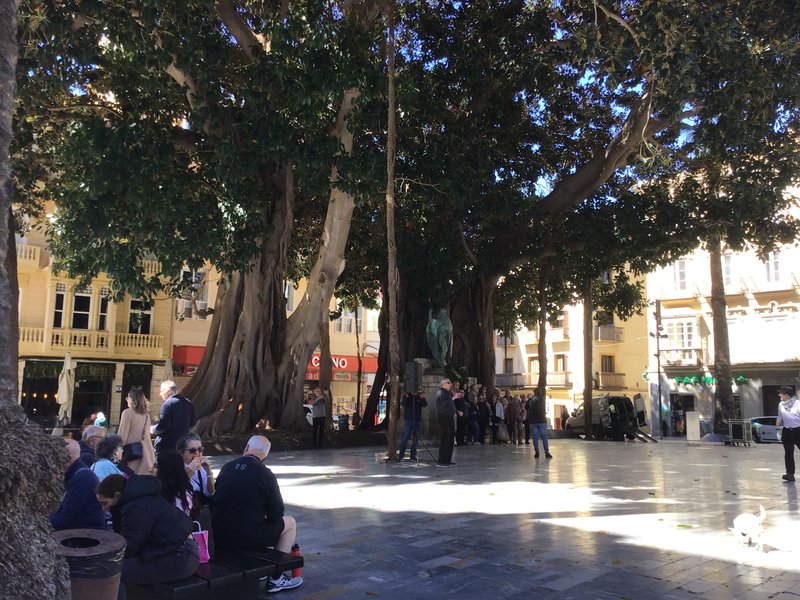
Hilo Banyan Tree
Hilo: Han Standing in the rain at the market
Hilo Fresh Market
Papaya price is the same as in grocery stores?
Pacific warrior ornaments
Maybe a waterfront movie theatre?
Vegetarian lunch for TJ
Exterior Wall painting about Hawaii
Reaching back to a proud past.
Hilo Local cano race competition training

Load more